
AI agents
judgement over language, within limits
When a task requires understanding freely written text, summarising it or drafting a reply, and a fixed rule falls short.
When you need it
Some work admits no description by rules because the input is not predictable: an email where a customer sets out their case in their own terms, a twenty-page document you need four figures from, an enquiry that mixes three separate matters.
A deterministic flow does not cover that case: the rule would have to anticipate every possible formulation of the same request.
An agent does cover it, provided it is bounded. That means defining which actions it is permitted, what level of human supervision each task carries, and how you verify afterwards that it acted as defined.
What we do
Scope definition
The scope is set down in writing: which tasks the agent takes on, which fall outside it, and under what conditions it hands over to a person. A bounded scope admits acceptance criteria and later evaluation; an open scope does not.
Level of supervision
Each task is assigned in writing to one of the two regimes. That decision governs where the control points sit, the cost of running the system, and compliance with Article 22 of the GDPR. Left undefined, each employee sets it independently.
- HITLHuman in the loop
- A person validates every output before it takes effect. The agent proposes; it does not execute.
- HOTLHuman on the loop
- The agent executes and a person supervises the whole, with the ability to intervene, correct and reverse.
Architecture and orchestration
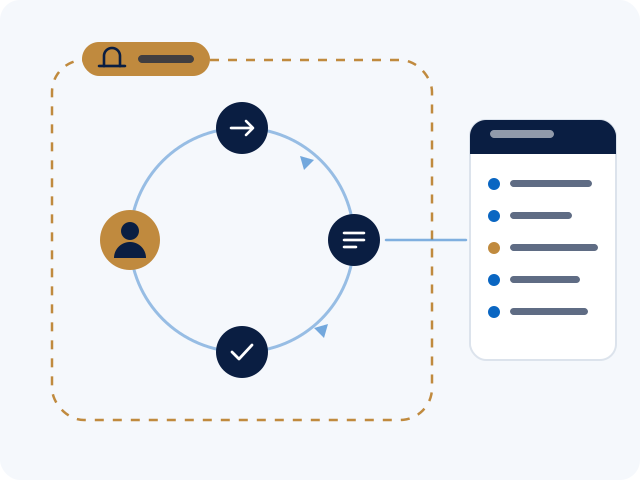
The agent interprets, the orchestration loop decides the next step and the deterministic flow executes. Guardrails limit which actions are possible, not merely which answers are desirable, and connectors bound which systems and which data it can reach.
Evaluation and traceability
Every run leaves a record of the input, the decision and the output. A periodic sample is evaluated against criteria set in advance, and thresholds are established that trigger an adjustment or the pause protocol.
What you leave with
- The documented architecture: the orchestration loop, the connectors and APIs it reaches, and the guardrails limiting which actions it can execute.
- The instructions and behaviour policies —what it must do, how it must answer and what is forbidden to it— in a versioned document, not only inside the tool.
- The level of supervision assigned to each task, HITL or HOTL, with the validation points placed in the circuit.
- The activity logs for every run, detailed enough to review them and to evidence them to a third party.
- The pause protocol: in which cases the agent is stopped, who takes over its work meanwhile, and what has to be reviewed before switching it back on.
We start by understanding what you do
The AI operations review goes through how your processes work today and which tools you use, and ends with a concrete recommendation on where to start. Half an hour. No commitment.